
I recently stumbled upon a somewhat provocative statement made in an article that featured in the National Geographic magazine. The piece claimed that the greatest innovation in the history of humankind has little to do with engineered tools or fire. It, to my surprise, is something much more abstract – the invention of symbolic expression. The need to convey meaning, both in time and space, it seems, outweighs many other human needs. And one can further posit that art and literature, with a blurred boundary separating the two, exist as a metamorphic form of the ancient cave paintings, collectively addressing this human need to express.
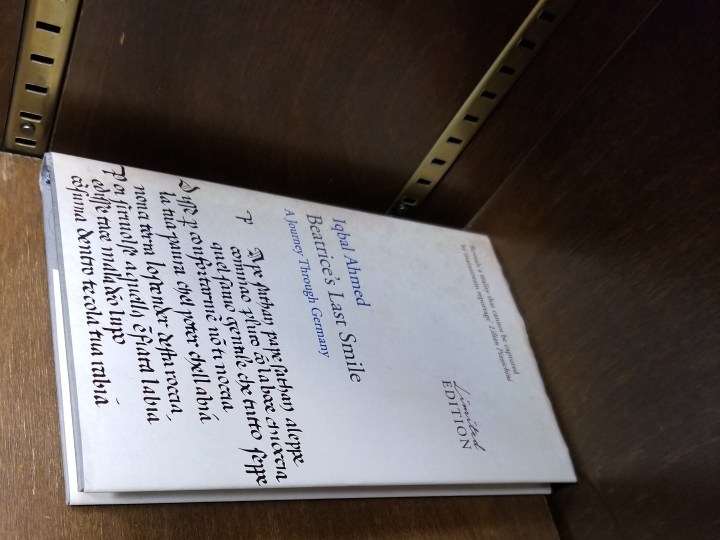
My copy of Beatrice’s Last Smile arrived by post. It was a gift from the author, Iqbal Ahmed, wrapped in the gold kraft paper. I had been expecting the package for more than a week. There was a label affixed to the endpaper. It stated a Limited Edition, with number 86 neatly typewritten within a printed circle, denoting a serial number of the signed copy. For me, it was yet another example, adding to the long list of personal experiences, reflecting author’s commitment to detail. Given the proliferation of digital media, it is quite a rarity to come across typewritten text these days – the one that gets delivered by post. Effort at one end and longing at the other – investments that are hard to consider trivial. This made the whole exercise feel all the more personal.
I was glad to receive my copy just in time for my trip to New Orleans. Travel Literature, described as its genre on the back cover, to be read during my travel time. This inadvertently expanded the notion of a literary classification from content to usage, which was inexplicably pleasing. The book cover mentioned that “Beatrice’s Last Smile completes what is in effect an informal trilogy about the immigrant experience, with its attendant themes of displacement and marginality.” To those who are not acquainted with Ahmed’s work, this summary brings forth the otherwise elusive connection between the poetic title of the book and its subtitle – A Journey Through Germany.
Within three days of laying my hands on it, I succeeded to go from cover to cover of this book. I have read Ahmed’s other two books, Sorrows of the Moon and Empire of the Mind, and found the form of expression in Beatrice’s Last Smile holding on to the form of Ahmed’s previous work. The writing style stays true to, what one may call, a desirable simplicity in written word. The template of narration from his previous work is also preserved, enabling this book to be viewed as the third one in an ‘informal’ trilogy. Unlike, let’s say, my writing habits, with the pervasiveness of subordinate clauses, commas, dashes, and even words, Beatrice’s Last Smile delivers literature in carefully measured and clean sentences. Like its predecessors, this book is divided into ten chapters. Having known the author personally, perhaps even this is done to borrow some beauty from the symmetry of the decimal system.
Beatrice’s Last Smile captures the open-ended stories chosen by the author from the lives of a diverse group of people, dwelling on both their uniqueness and intersections. These are the people who have left their native lands and settled in different places across the length and breadth of Germany. The depiction of their lives encapsulates not only their reality but their dreams as well – capturing the perpetual oscillation between the personal universe that could have been and the one that actually is. A close second to what Nietzsche calls Das schwerste Gewicht or the heaviest weight. Apart from the adept portrayal of people, this book nicely architectures the backdrop of the cities in the reader’s mind. The book explains the historical as well as the current landscape in which its immigrant experience takes place. And all that detailed, detached observation is interspersed with Ahmed’s own life experience – the one which is poetically, melancholically, metaphorically, and actually divided between his two homes – in Kashmir and in Europe.
If home is found on both sides of the globe,
home is of course here—and always a missed land.
One is tempted to use these lines from Agha Shahid Ali’s poem, Land, as a prelude to the touching prose in Beatrice’s Last Smile. Ahmed’s personality, while reading the book, does not get reduced to just a keen observer and a skillful narrator. It reflects as more. Most noticeably, he comes off as someone who can make beautiful literary connections – between art, architecture, history, and sociology of Kashmir and Europe. The politics of the book, on the other hand, is only invoked with quietude and subtlety, which can be easily missed if one does not pay attention. The closing lines of several chapters try to urge awareness and action, building on lessons that one naturally learns after the book takes us through some of the darkest periods of European history. The author enriches and entertains through intellectual discourse and profuse references, refusing to make up content, like many would do, with easy recourse to wordplay; nonetheless, one at times misses a more pronounced rendition of opinion and analysis. Ahmed, on the other hand, does grapple, like existentialists do against ennui, with what I would like to call The Philosophy of Home. He weaves a garment of words, with a European design, using authentic Cashmere threads. He contemplates on Borges contemplating on Dante contemplating on his beloved, Beatrice, and especially her last smile.
We live in a world with information overload. It is not a necessity anymore to memorize bare facts. They can be easily googled, as the website lmgtfy.com signifies. In my opinion, this web application is one of the funniest pieces of contemporary satire. The acronym stands for let me google that for you. If facts are now preserved and conveyed by other means, what then does remain the task of literature? Literature, unlike Google, is still able to convey the space of emotions in which facts exist. For such a difficult job, Beatrice’s Last Smile performs very well. It attempts to leave the readers more knowledgeable and more empathetic once they are finished reading the book.
I would like to revisit the National Geographic article that I mentioned at the very start – how it refers to the human need to express, and how that, in turn, is related to the umbrella term Art. For those of you who don’t know it, Iqbal Ahmed is my uncle. We often exchange texts and pictures on WhatsApp. Earlier this year, I was visiting Geneva and decided to pay a visit to Musée d’Art et d’Histoire, the Museum of Art and History in the city. I came across a couple of minimalist paintings themed on contemporary abstract art, in an otherwise rich collection spanning from middle ages to the early twentieth century. One painting depicted a circle and another four lines. I found it funny and sent a picture to my uncle with the caption – suffering from art. To which, as a metaphor that runs very deep, he replied, “Rather, suffering for it.”
***
(Beatrice’s Last Smile is available online.)
 Entropy of Words
Really interesting.
Thanks for sharing.
LikeLiked by 1 person